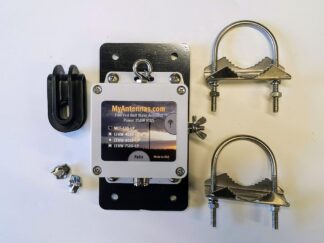
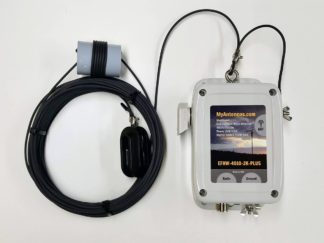
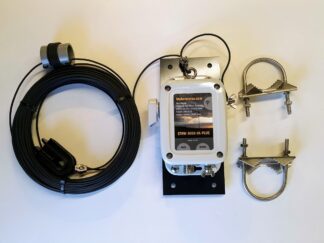
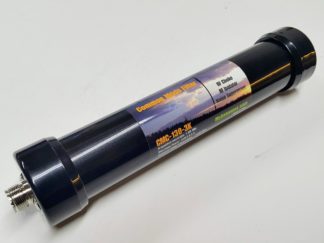
Short answers to the questions we get most about common mode chokes (CMC) and RF line isolators, written by Danny Horvat, E73M / N4EXA, designer of the MyAntennas CMC line and an antenna engineer for 45+ years. For the full technical background, see About CMC.
CMC Basics
What is a common mode choke (CMC)?
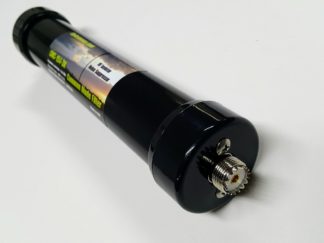
A CMC, also called a line isolator or current choke, blocks RF current flowing on the outside of the coax shield. Your signal travels inside the coax as differential-mode current, and the choke doesn’t touch it. Current on the outside of the braid is common-mode: it turns the coax into an unintended antenna that radiates RF into the shack and picks up household noise.
A good choke adds high resistive impedance in the path of that outside current. The unwanted RF is dissipated as a small amount of heat instead of being reflected or resonating.
Is a CMC the same as a 1:1 BALUN?
A 1:1 current BALUN at a dipole feed point is a common mode choke doing a specific job: forcing equal currents into both halves of a balanced antenna. A line isolator is the same principle used anywhere on the line, usually at the entry to the house, to stop noise and RF from riding the shield.
Voltage BALUNs are different. They pass the full transmitted power through the core and do little to stop common-mode current. That’s why we build current-type designs. See About BALUNs.
Do I need a CMC?
Not always. If your coax shield is grounded where it enters the house and the cable runs on or in the ground, you may not need one. I run 1500 W on my EFHW that way.
You do need one if:
- Your computer resets, your Wi-Fi drops, or your TV or speakers act up when you transmit.
- You feel RF on the microphone or key (“bitey mic”).
- SWR changes when you touch or move the coax.
- Your receive noise floor is high and drops when you disconnect the antenna.
- The coax isn’t grounded outside before it enters the house.
Won’t better grounding fix my RFI instead?
No. Grounding is for lightning and electrical safety, and NEC Article 810 requires it. But a long ground wire is just another antenna at HF, and the earth is not a sink that makes RF disappear. RF problems are solved by breaking the common-mode path with a choke, and by bonding the equipment in your shack together with short, direct connections. See About Grounding.
Choosing a Model
Which CMC should I buy?
| Model | Frequency | Power | Best for |
|---|---|---|---|
| CMC-130-3K | 1–30 MHz | 3 kW | Any HF station, 160–10m, up to legal limit |
| CMC-154-3K | 1–54 MHz | 3 kW | HF plus 6m on the same feedline |
| CMC-0510-R | Receive only | Not for TX | Receive antennas, MW DX and 160m listening |
The CMC-130-3K has at least 10,000 ? of choking impedance from 3.8 to 30 MHz, over 5,000 ? on 160m, and up to about 15,000 ? on 10m.
Do I need the 6m version?
Only if the same coax carries 6m. If 6m runs on its own feedline, the CMC-130-3K is the right choice for HF.
Is 3 kW enough for my amplifier?
Yes. A choke only handles the common-mode current on the shield, not your transmitted power, so a 3 kW rating gives a large margin for any legal-limit station. If a choke gets warm, that is a sign of heavy common-mode current, and the cause is in the antenna or the feedline layout.
Can I use two chokes in series?
Yes. Two chokes add impedance or extend frequency coverage. If you combine different types, put the one that covers the highest frequency closest to the equipment you’re protecting.
What about receive-only antennas?
Use the CMC-0510-R. Receive antennas such as Beverages, loops and active whips are very sensitive to noise coupled onto the coax shield, and a receive choke at the entry point or at the receiver lowers the noise floor. It is not rated for transmitting.
Placement and Installation
Where should I install the CMC?
Where the coax enters your house, on the antenna side of the grounding point. A choke works best where the unwanted current enters or leaves the cable, and that is the entry point.
The order outside the house is:
- Antenna
- CMC
- Grounding point (entry panel, pass-through SO-239 plate or arrestor body, per NEC Article 810)
- Into the house to the radio
Why doesn’t a CMC work when I put it behind the radio?
Because the ground wire bypasses it. If the CMC is at the radio and a ground wire runs from the radio chassis to a ground rod outside, the common-mode current simply takes that wire around the choke. Move the CMC outside, ahead of the grounding point.
Should I put a CMC at the antenna feed point?
It depends on the antenna.
- Dipoles, OCF dipoles, Yagis and other balanced antennas: yes, use a 1:1 current BALUN or choke right at the feed point to keep RF off the coax. Then add a CMC at the entry point if you still have noise.
- EFHW antennas: no. We don’t recommend any choke at an EFHW transformer. Put the CMC at the entry point. See the EFHW Antenna FAQ.
Does it matter which end of the CMC faces the antenna?
No. The choke is symmetrical and works the same in either direction.
Do I need a CMC on every coax line?
On every transmit feedline that enters the house, yes, if you have RF or noise problems. Rotator cables, remote switch cables and control lines can carry RF and noise too, and they need chokes as well.
RFI and Receive Noise
How much will a CMC lower my noise floor?
When the noise is coming in on the coax shield, typically one S-unit or more. Where house wiring was coupling heavily onto the feedline, we’ve seen 4–5 S-units. If the noise reaches your antenna over the air, no choke can remove it.
I installed a CMC and the noise is still there. Why?
Then the noise probably isn’t coming in on the shield. Check it this way:
- Disconnect the antenna. If the noise drops to your radio’s own floor, it comes from outside the radio. If it stays, the source is in the shack.
- Run the radio on battery and switch off the main breaker. What you still hear is the neighborhood noise floor.
- Turn circuits back on one at a time. When the noise returns, find the device on that circuit.
Common offenders: LED lighting drivers, dimmers, wall-wart chargers, solar inverters and charge controllers, variable-speed HVAC motors, Ethernet switches and cable or DSL modems. A noisy device needs a choke on every cable connected to it, including the power cord.
Also keep in mind that band noise is supposed to rise by about 10 dB when the band opens. That’s propagation, not a fault.
Will snap-on ferrites fix my RFI?
Not on HF. A single snap-on bead adds too little impedance at HF to do anything useful; a choke has to pass a threshold before you hear any improvement. You need multiple turns of cable through the right ferrite, or a purpose-built choke. Snap-ons work better at VHF and up.
Does a coil of coax work as a choke?
Poorly, and it can make things worse. A coiled-coax choke is mostly inductive with almost no resistance. If its reactance cancels the reactance of the feedline’s common-mode path, the two resonate and the common-mode current goes up. In G3TXQ’s measurements, a reactive choke in the wrong place nearly quadrupled the current on the braid. Ferrite chokes with high resistive impedance don’t have that problem.
Do power-line filters help?
Rarely. Most plug-in AC filters only treat differential-mode noise, and the safety ground wire carries the common-mode noise right past them. A common mode choke on the power cord is far more effective.
Technical Questions
How much choking impedance do I need?
About 1,000 ? is enough to keep RF from distorting an antenna’s pattern. For real noise and RFI suppression, aim for 5,000 ? or more across the bands you use. Every doubling of choking impedance gives roughly another 6 dB of common-mode reduction. That’s why the CMC-130-3K is built for 10,000 ? or more across most of HF.
Why does resistive impedance matter more than inductance?
Resistance always reduces current. Reactance can resonate with the feedline’s own common-mode reactance and increase the current instead. A good choke is mostly resistive across its whole frequency range, so it works on every band no matter how long the feedline is. This is why turns, core size and ferrite material have to be chosen together and measured, not guessed.
Which ferrite material is best for HF chokes?
Fair-Rite #31 is the best general-purpose HF material, effective from about 1.5 MHz upward and clearly better than #43 below about 5 MHz. #43 does slightly better above about 14 MHz, and #61 is for VHF/UHF. More turns raise the impedance on the low bands, at some cost on the high bands. The turns must be wound in sequence; crossed turns partly cancel.
Will a CMC change my SWR?
Not on a properly fed antenna. If your SWR changes after you add a choke, the coax shield was acting as part of the antenna. The choke removed it, and you are now seeing the antenna’s true SWR. That is the choke doing its job.